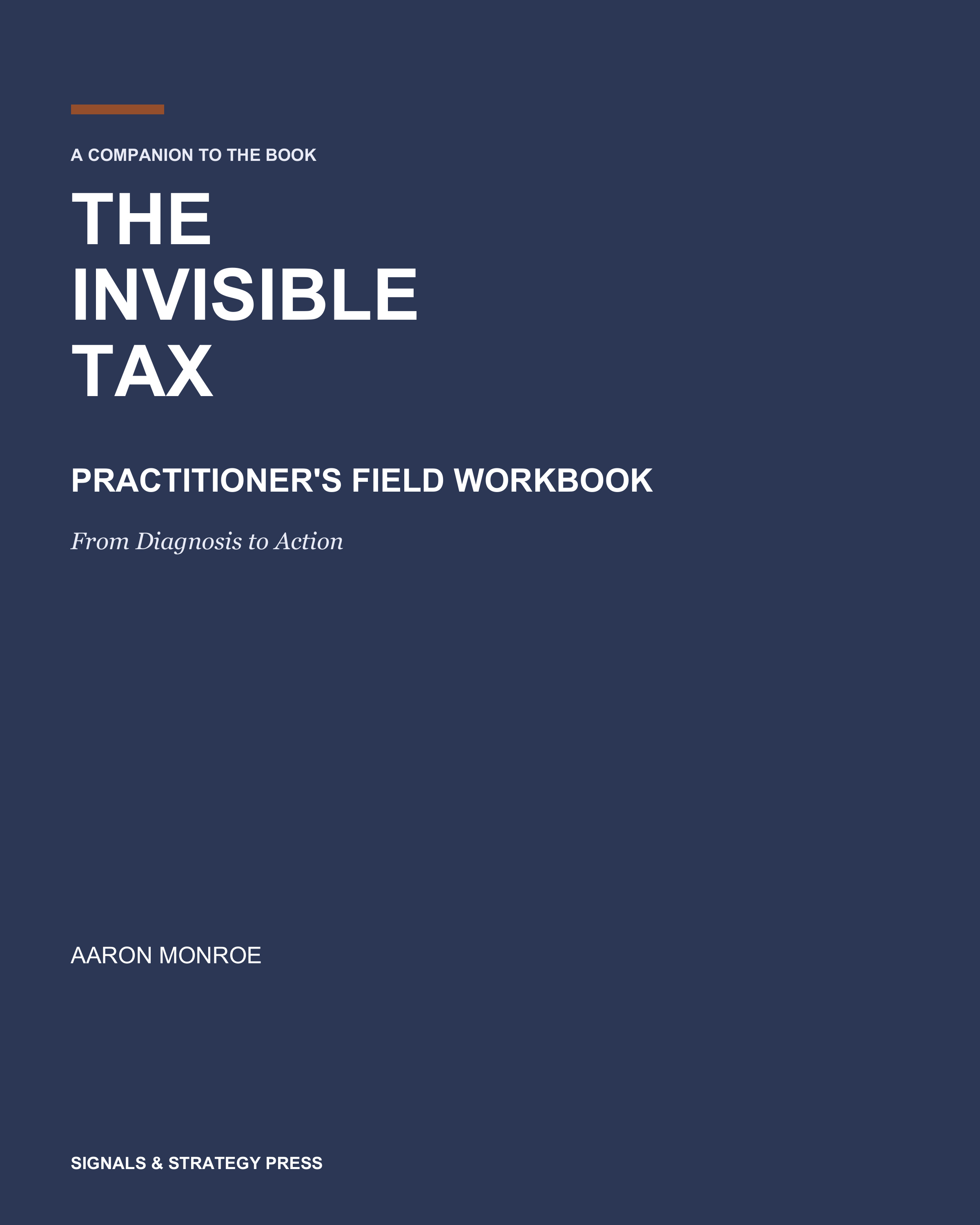
The Invisible Tax: Practitioner's Field Workbook
From Diagnosis to Action
Turn the ideas in The Invisible Tax into a disciplined practice. Ten exercises across six weeks help you locate coordination costs, test assumptions, and move from diagnosis to action.
By Aaron Monroe
- Formats
- Paperback
- Publication
- September 2026
About the book
The Invisible Tax: Practitioner's Field Workbook is the practical application companion to Aaron Monroe's The Invisible Tax. Ten exercises across six weeks guide readers through the Map, Assess, Repair, Maintain cycle, turning organizational friction into a case they can examine and act on.
Map the seams where work crosses boundaries, make waiting and repeated verification visible, and test what the work actually requires. Then design one bounded repair, build the case for it, record what happened, and establish a rhythm for revisiting the results.
Designed for leaders, practitioners, and teams applying the book's framework, this workbook encourages checkable evidence and careful judgment. The aim is to reduce avoidable coordination costs while recognizing the controls and constraints that serve a necessary purpose.
About the author

Aaron Monroe
Author • Thinker • Change Leader
United States
Aaron Monroe is the author of The Invisible Tax: Why Better Technology Cannot Fix a Disconnected Organization.
His work explores a persistent question: why do capable people, clear intentions, and powerful tools so often fail to produce collective movement? Drawing on years of experience inside large organizations and transformation work, he examines the hidden costs that accumulate between teams, functions, leaders, and decisions.
Aaron began his corporate career as a college student working on General Electric's Executive IT Helpdesk, supporting senior leaders from GE's headquarters in Fairfield, Connecticut, and its offices at 30 Rockefeller Plaza. That early view of a formidable operating system, and the people and relationships beneath it, helped shape questions he would carry throughout his career.
In The Invisible Tax, he combines a fictional business narrative with research and a practical operating framework. The form reflects his broader writing interests: ideas are often easier to understand when readers can first see them happening to people.
His work is guided by a simple ambition: help people see more clearly, think more deeply, and act with purpose.
Newsletter
Find the signal worth keeping.
Receive new writing, book updates, and occasional recommendations for work worth your attention. Thoughtful, useful, and sent only when there is something to say.
No noise. No inbox games. Unsubscribe at any time.