BRMConnect 2026 Field Guide
Where Is Your Organization Paying the Invisible Tax?
Applying the Invisible Tax Through Business Relationship Management
Share your experience of where coordination costs show up in your organization, and receive a complimentary digital copy of The Invisible Tax: BRMConnect 2026 Field Guide by Aaron Monroe. You can download it as soon as you finish, and the same secure link is emailed to you as a backup. It works on a phone.
Take the survey
Where Is Your Organization Paying the Invisible Tax?
Ten questions about where coordination costs show up in your organization. The first five are required and the rest are optional. Share your experience and your complimentary digital BRMConnect 2026 Field Guide is ready to download the moment you finish, with the same secure link emailed to you as a backup. There is no purchase and nothing to pick up in person.
Infographics
Two-Page Handouts
These are separate resources from the BRMConnect 2026 Field Guide and from the complete Practitioner’s Field Workbook. No survey is needed: download either handout directly.
Book Infographic
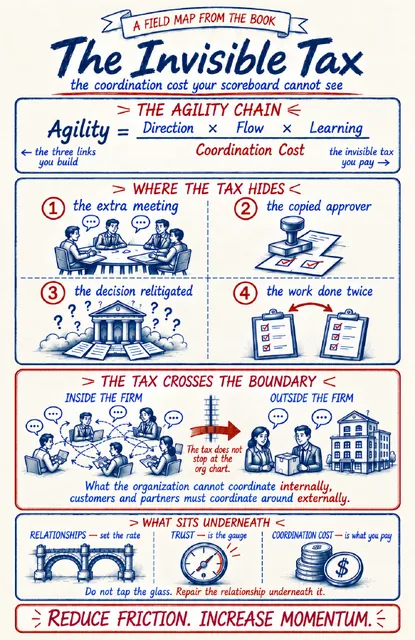
A two-page visual map of The Invisible Tax, its underlying relationships, and the Map–Assess–Repair–Maintain cycle.
Download book infographic (PDF)PDF, 2 pages, 6.8 MB
Keynote Infographic
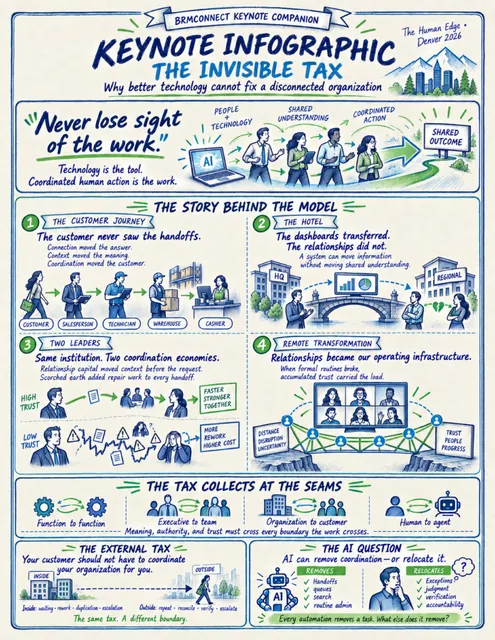
A two-page companion to the BRMConnect keynote, including the seam test and practical steps for diagnosing and repairing cross-team friction.
Download keynote infographic (PDF)PDF, 2 pages, 7.9 MB
Optional reading
About the Field Guide
Begin During the Conference. Leave With One Bounded Action.
The BRMConnect 2026 Field Guide helps you apply the central ideas of The Invisible Tax to one consequential initiative, decision, service, product change, or operating issue. You can begin during the conference, test your reading with a peer, and leave with one bounded 30-day action.
You do not need to have read the book before beginning. The Field Guide provides the definitions and guidance needed to start, while the book provides the deeper method and context.
The short path
Diagnose > Map > Translate > Test AI > Intervene > Act
A practical field instrument, not a scored assessment, quiz, or online course, and not a replacement for the book.
The sequence
Six Modules, One Rehearsal
Module 1
BRM Invisible Tax Diagnostic
Notice observable signals of avoidable coordination cost without manufacturing a score.
Module 2
Boundary Map
Compare how roles understand a consequential boundary and identify where coordination breaks down.
Module 3
Value Translation Exercise
Make different definitions of value visible and connect them to checkable evidence.
Module 4
AI Amplification Test
Distinguish what greater speed may improve from what it may make costly faster.
Module 5
BRM Intervention Map
Select one bounded mechanism to change while keeping accountability with the accountable roles.
Peer Debrief and Rehearsal | Unnumbered Practice
Peer Debrief and Rehearsal
Invite a colleague to challenge the reasoning and practice explaining the findings before approaching more influential stakeholders.
Module 6
30-Day BRM Action Plan
Run one evidence-based test and decide whether to continue, adapt, or stop.
Peer Debrief and Rehearsal sits between Module 5 and Module 6 and is not numbered. The 30-Day BRM Action Plan remains Module 6.
How BRM is framed
Capabilities, Not Titles
In this edition, unless otherwise indicated, Business Relationship Management is treated as the capabilities that help an organization build repeatable capacity for shared understanding, cross-boundary decisions, productive disagreement, and value recognition. Anyone can apply those capabilities, regardless of role or title. When a formally designated BRM role is intended, the text says so explicitly.
Accountability remains with accountable roles. BRM capabilities can improve the mechanisms that carry coordination. They do not transfer ownership of a product, decision, delivery, risk, or business result.
Where both are meant, the Field Guide refers to the BRM or the person applying BRM capabilities.
Before you begin
Orientation
- Select one consequential initiative, decision, service, product change, or operating issue and carry it through the Field Guide.
- Treat conference entries as provisional.
- Memory provides a lead or a question, not proof.
- Use functional roles, never personal names.
- Keep observation, checkable evidence, inference, and alternative explanation separate.
- Mark Unknown rather than filling a gap with confidence.
- Verify records and missing perspectives after returning to work.
- A peer can test the logic and clarity of a reading but cannot validate facts about another organization.
- Not every delay, control, technical fault, legal requirement, safety constraint, or data problem is Coordination Cost.
Essential terms
Definitions Used Here
- Invisible Tax or Coordination Cost
- Avoidable additional alignment, verification, escalation, waiting, rework, and repair required when roles cannot rely on one another enough to coordinate directly.
- Seam
- A boundary where work, information, authority, or accountability passes between roles, teams, systems, or partners.
- Checkable evidence
- A record or observation another person could inspect, such as a dated decision log, approval trail, queue timestamp, revision history, or recurring meeting record.
- Bounded intervention
- A limited change to one coordination mechanism, with an owner, a review date, and an observable indicator.
Already have access?
Recover my Field Guide
Enter the email address you used when you completed the BRMConnect survey. If it belongs to an authorized Field Guide reader, a fresh secure link is on its way. A new link replaces any earlier one. You can download the PDF again until your link expires, eight hours after it was issued. Save a copy to your device for later.
Read the book
Read The Invisible Tax
The Invisible Tax examines the hidden cost organizations pay when trust, relationships, alignment, and operating mechanisms fail to keep pace with technology, talent, and ambition. It is available in paperback and Kindle on Amazon; the purchase links sit with the survey above.
Physical workbook
Prefer to Work on Paper?
The complete Practitioner’s Field Workbook: From Diagnosis to Action is the permanent implementation companion to The Invisible Tax. The paperback is available on Amazon; the purchase link sits with the survey above.
Need help accessing your Field Guide? Contact Signals & Strategy Press. This page lives permanently at signalsandstrategypress.com/brmconnect.
Publication information
Independence and Scope
These modules are diagnostic application prompts. They produce provisional readings, not scores. They do not rank organizations, teams, people, or relationships and are not an official BRM Institute method, maturity assessment, benchmark, certification, or advice on a specific business, legal, financial, employment, technology, privacy, safety, or risk decision.
BRMConnect is referenced solely to identify the conference context. This publication is independently authored and published by Aaron Monroe and Signals & Strategy Press. It is not an official publication of, sponsored by, or endorsed by BRM Institute.
The views expressed are the author’s own and do not represent the views of any employer, past or present.