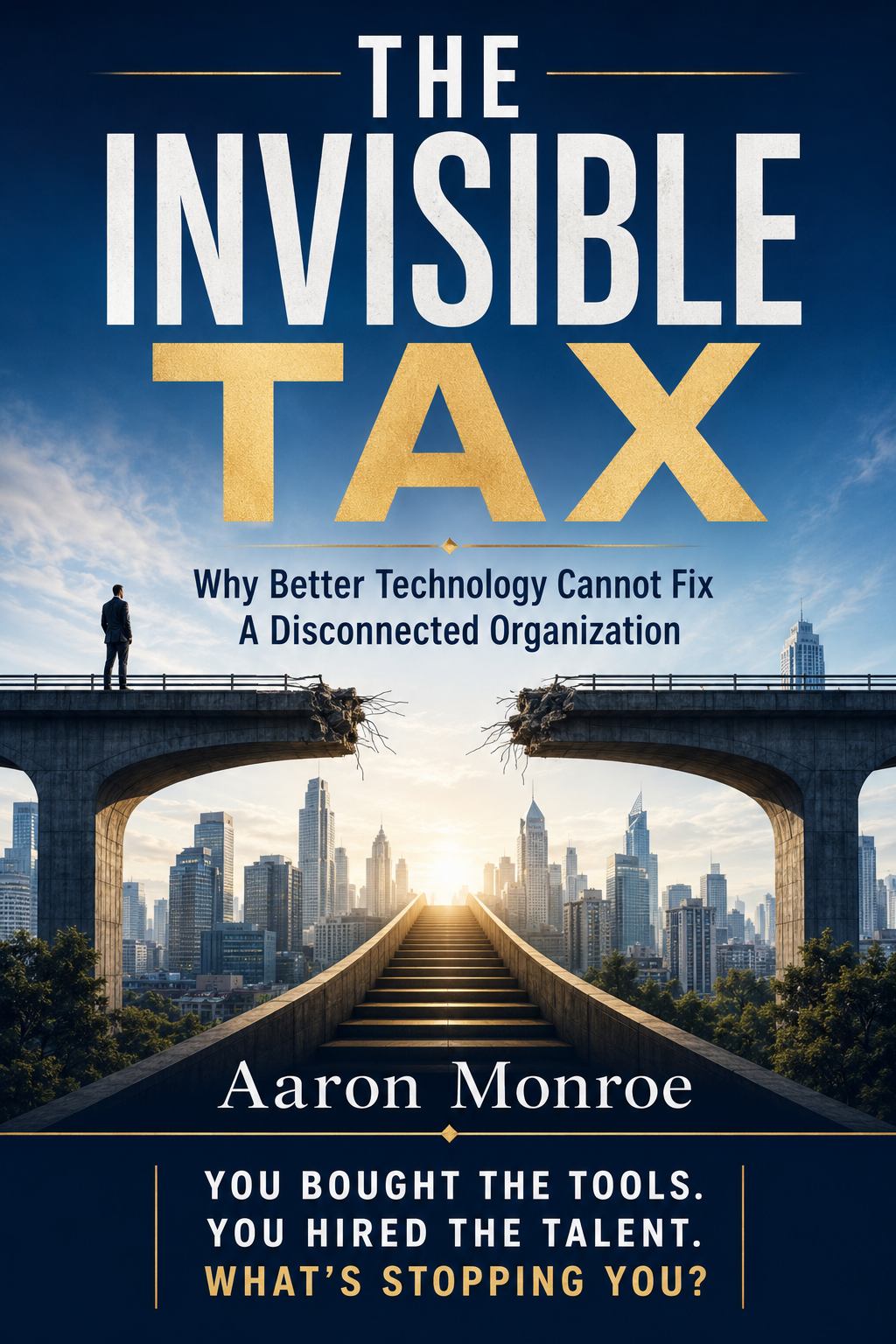
The Invisible Tax
Why Better Technology Cannot Fix a Disconnected Organization
Organizations keep buying better tools, adding more automation, and now deploying AI, yet work still slows at the seams between roles, teams, and decisions. The Invisible Tax names the hidden coordination cost created by organizational disconnection and shows leaders how to see where it accumulates, understand what the work actually requires, and reduce the burden without confusing necessary friction with waste.
By Aaron Monroe
- Formats
- Paperback and eBook available now. Audiobook (forthcoming).
- Publication
- September 2026
About the book
AI makes capable organizations faster. It can make disconnected organizations faster at the wrong things.
The Invisible Tax combines an original business story with a practical framework for diagnosing the hidden coordination costs that accumulate between teams, functions, and leaders. It shows why technology alone cannot repair weak direction, broken flow, slow learning, or relationships that cannot carry shared accountability under pressure.
For leaders navigating AI transformation, organizational change, and cross-functional work, this is a book about finding the real constraint before investing in another solution.
Organizations are investing in AI to move faster, make better decisions, and unlock new value. Yet many discover a frustrating contradiction: the tools improve, individual productivity rises, and the organization remains slow.
The missing cost often sits between the boxes on the organization chart.
It appears when one team cannot rely on another. When every handoff requires another meeting. When credible warnings die on the way upward. When leaders agree in the room and leave with different decisions. When people protect local performance while the whole system pays the price.
Aaron Monroe calls this cost the Invisible Tax.
Part business narrative and part practical operating framework, The Invisible Tax follows Maya Chen as she enters Meridian Financial to diagnose a celebrated AI transformation that is producing activity without value. What she finds is not a simple technology failure. It is an organization whose relationships, decisions, incentives, and seams cannot carry the speed its tools can create.
The second half of the book turns that story into a disciplined way of seeing. Readers learn to examine Direction, Flow, Learning, Coordination Cost, relationships, and trust without reducing complex human systems to a slogan or a score.
The central argument is direct: AI multiplies the operating conditions already present. Put it inside a healthy system and momentum compounds. Put it inside a fragmented one and the easy work gets faster while the hardest work remains stuck.
The framework
The framework behind the Invisible Tax.
- 01
Direction
Can people make coherent choices because priorities and tradeoffs are actually clear?
- 02
Flow
Can work move across the organization without unnecessary waiting, translation, rework, or escalation?
- 03
Learning
Can credible information change what the organization believes and does; especially when the truth is inconvenient?
- 04
Coordination Cost
What must people spend to align, verify, transfer, repair, and move work across the seams that matter?
- 05
Relationships and trust
Can people rely on one another enough to exercise judgment, share accountability, challenge assumptions, and act under ambiguity?
Who it is for
The Invisible Tax is written for executives, transformation leaders, technology leaders, strategists, operators, consultants, and team leaders responsible for work that must cross boundaries. It is especially relevant for readers asking:
- Why are our tools improving while the organization still feels slow?
- Why do decisions repeatedly reopen after everyone agreed?
- Why does transformation produce activity without corresponding value?
- Which coordination burdens are necessary, and which are signs of a deeper constraint?
- Where can AI reduce friction, and where does human judgment remain essential?
- How do we know whether the binding problem is technical, structural, or relational?
Excerpt
Read the opening of The Invisible Tax and meet Maya Chen on the first day of a transformation that looks successful from every dashboard; and broken everywhere the work is real.
The dashboard on the wall of the Meridian Financial executive floor was, by every measure it had been built to report, a success. Adoption: ninety-four percent. Model latency: down. Analyst hours recovered: eleven thousand and counting.
Maya Chen had been in the building for forty minutes and had already heard three people apologize for a delay.
That was the thing about a number on a wall. It could be true and still tell you nothing about whether the work could move.
The companion
The Invisible Tax: Practitioner's Field Workbook
From Diagnosis to Action
The practical application companion to The Invisible Tax. Ten exercises across six weeks take a leadership team from diagnosis to action: locating where coordination cost accumulates, testing what the work actually requires, and choosing changes that reduce the burden without mistaking necessary friction for waste.
Get the workbook- Exercises
- 10
- Weeks
- 6
- How teams use it
- A guided sequence for leadership teams moving from diagnosis to action, one exercise at a time.
About the author

Aaron Monroe
Author • Thinker • Change Leader
United States
Aaron Monroe is the author of The Invisible Tax: Why Better Technology Cannot Fix a Disconnected Organization.
His work explores a persistent question: why do capable people, clear intentions, and powerful tools so often fail to produce collective movement? Drawing on years of experience inside large organizations and transformation work, he examines the hidden costs that accumulate between teams, functions, leaders, and decisions.
Aaron began his corporate career as a college student working on General Electric's Executive IT Helpdesk, supporting senior leaders from GE's headquarters in Fairfield, Connecticut, and its offices at 30 Rockefeller Plaza. That early view of a formidable operating system, and the people and relationships beneath it, helped shape questions he would carry throughout his career.
In The Invisible Tax, he combines a fictional business narrative with research and a practical operating framework. The form reflects his broader writing interests: ideas are often easier to understand when readers can first see them happening to people.
His work is guided by a simple ambition: help people see more clearly, think more deeply, and act with purpose.
Questions readers ask
Newsletter
Find the signal worth keeping.
Receive new writing, book updates, and occasional recommendations for work worth your attention. Thoughtful, useful, and sent only when there is something to say.
No noise. No inbox games. Unsubscribe at any time.